by Pawinnut Chaiyasuan
When floodwaters entered 776 households across five provinces in Southern Thailand in January 2025, the most immediate response emerged from community kitchens, neighborhood networks, household databases, and relationships of trust that community members had built over many years through collective development efforts. The January 2025 floods affected communities across Songkhla, Nakhon Si Thammarat, Pattani, Yala, and Narathiwat. Yet despite the scale of the event, local networks associated with Baan Mankong programme rapidly mobilized food distribution, evacuation support, household surveys, housing recovery, and inter-provincial resource sharing. Their response illustrates how capacities developed through everyday community development activities can become the foundation of resilience during emergencies.
The case challenges conventional assumptions that disaster management is primarily a technical or administrative function. Instead, it suggests that resilience is fundamentally social. Communities that organize collectively during ordinary times are better equipped to coordinate, adapt, and recover when extraordinary events occur.
What Ordinary-Time Data Made Possible
In Satun Province, January floodwaters reached almost two meters, a level that had not been seen in twenty years. Few households had experienced anything on that scale. Yet when the evacuation order came, Baan Mankhong community was able to identify and move its most vulnerable members, elderly people, young children, people with disabilities, before conditions became life-threatening. The reason was not luck but it was data.
“We move with our monthly data. We know how many elderly people live in each house and how many children so we could evacuate those groups first, right on time even when some residents didn’t believe the warning at first.”
– Community network coordinator, Satun Province
Baan Mankhong program’s household survey systems, originally designed for housing development planning, proved equally functional as triage and coordination tools during the crisis. The capacities communities build for ordinary development are the same capacities that determine how they survive extraordinary disruption. Community networks used these data systems to reach all 776 affected households across 25 districts and 60 sub-districts, and to map repair needs in the immediate aftermath. The coordinating survey, a shared Google Form, deployed across five provinces. It reflected the network’s routine data culture which is decentralized collection, rapid aggregation, and immediate operational use.
The Communal Kitchen as Infrastructure
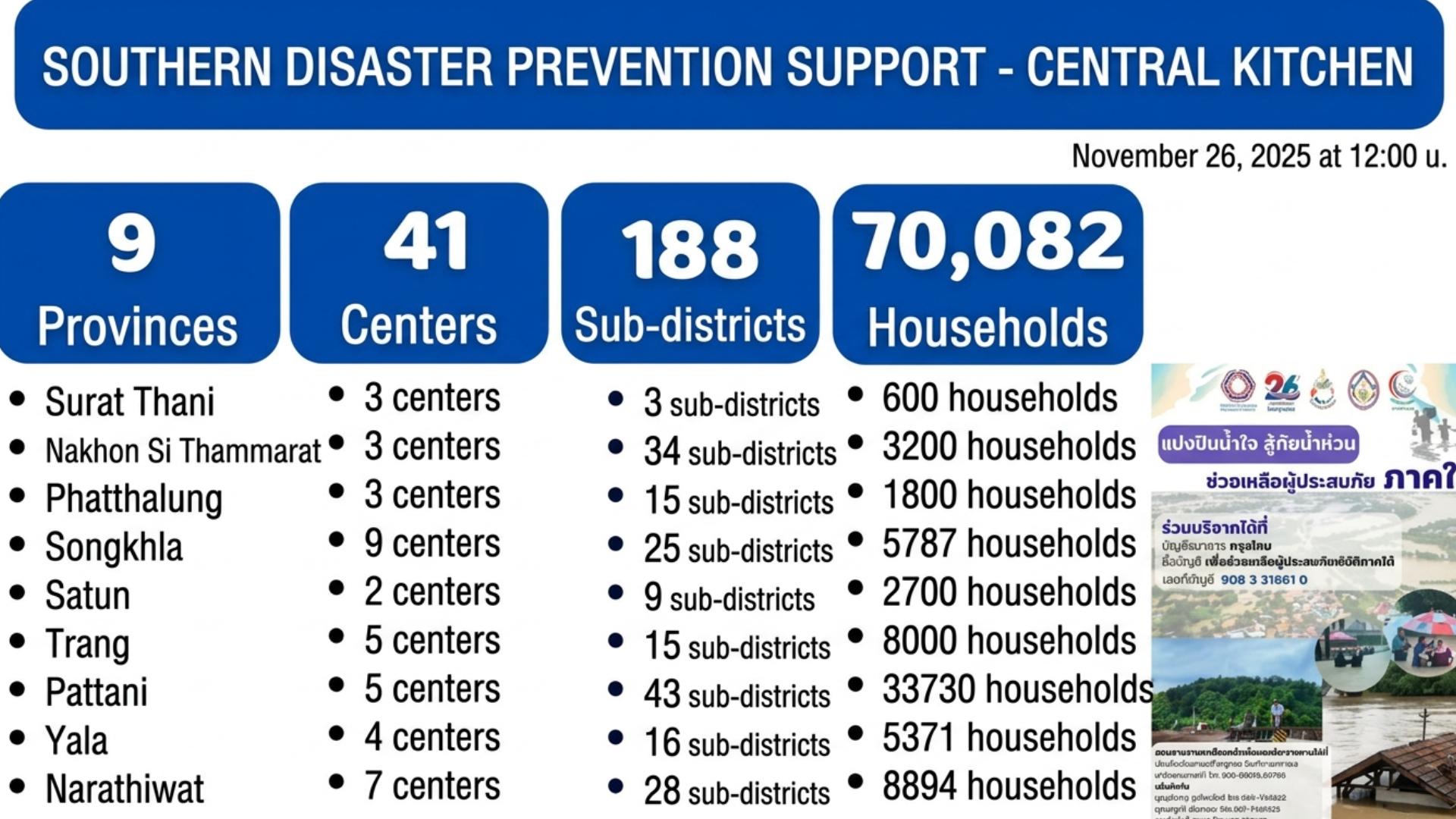
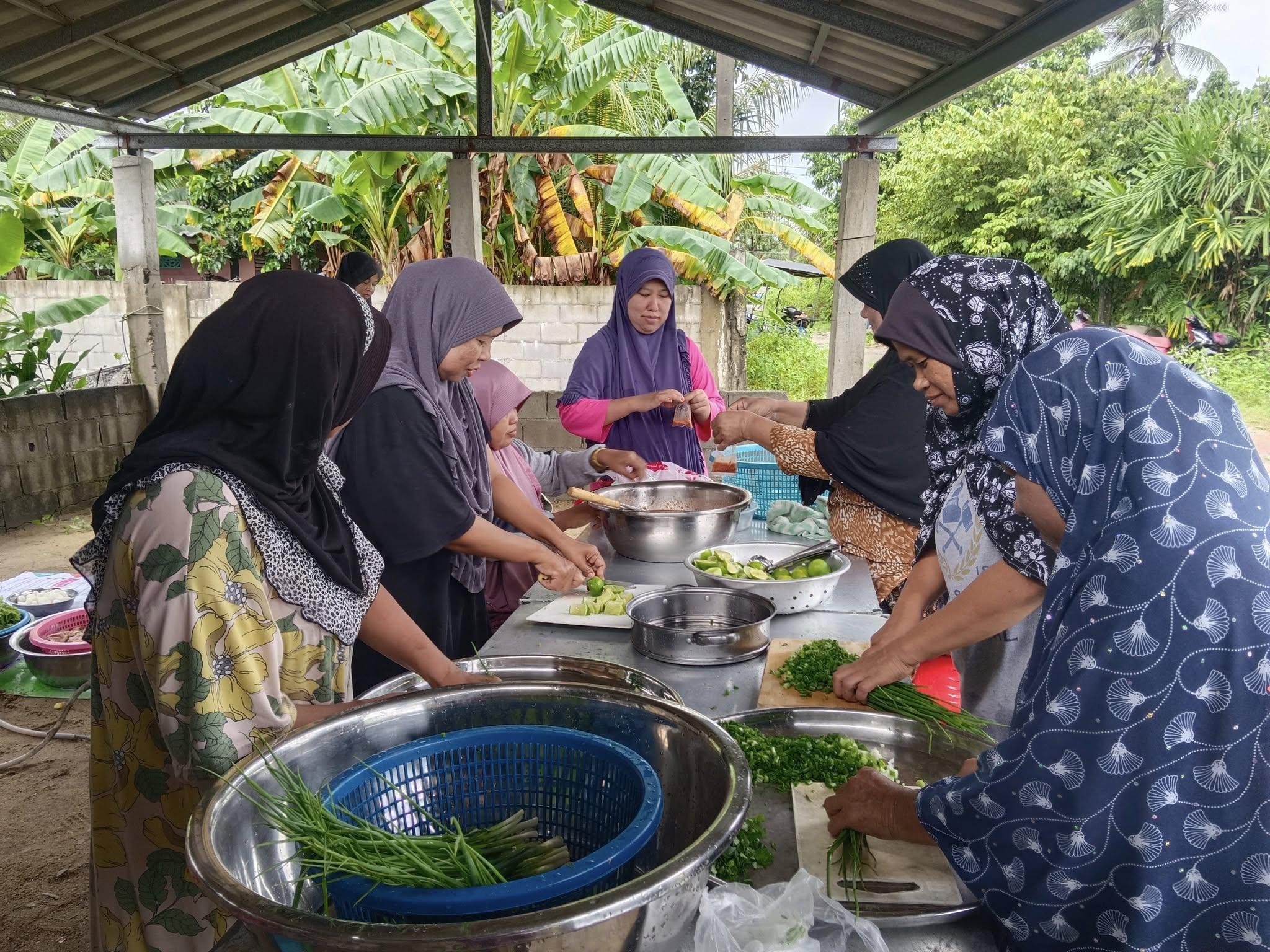
Within days of the crisis, Baan Mankhong networks established “central kitchens” at dozens of community sites across all five provinces. These were supply-chain-linked operations that produced and distributed thousands of boxed meals daily to flooded households that could not cook, shop, or move safely.
In Narathiwat, 20 central kitchen sites distributed 10,600 boxed meals and 200 survival packs. In Pattani, 9 sites produced 5,600 meals. In Nakhon Si Thammarat, 6 sites distributed 6,000 meals while community networks simultaneously mobilized donations of rice and drinking water from various teams such as Southern Thai Community Association in Kanchanaburi Province and CODI’s Northeast regional office. In Yala, 4 sites produced 2,000 meals, with additional sub-district organizations receiving small operational grants of 1,500 baht each to sustain local response capacity. In Songkhla’s Hat Yai municipality, community kitchens produced khao mok gai, a traditional Southern Thai dish, and distributed over 1,500 meal sets, including targeted deliveries to bedridden residents and elderly households that could not leave their homes. The Nakhon Si Thammarat operation developed a distinctive model. The self-named “Curry Team” worked across three sub-district networks in Pak Phanang, Chian Yai, and Cha-uat, preparing food and survival packs that moved through the distribution chains of 17 sub-districts.
Central kitchens additionally acted as hubs for community organization when society risked fracturing. They became spaces where neighbors gathered, information flowed, and volunteers synchronized their efforts. The food was the medium through which the network maintained its structural coherence under stress.
State Regulations vs. Disaster Responses
State response was constrained by procurement rules, disbursement timelines, and inter-agency fragmentation not designed for a rapidly evolving flood.
“Disaster management doesn’t move fast enough the way the state does it. That’s what made the community organization network stand up and take the lead on coordination. Agencies couldn’t communicate with each other. It took residents to talk to agencies for things to get done.”
– Southern network coordinator
State and community capacity are not substitutes as they operate at different speeds with different strengths. State agencies carry legitimate authority, fiscal resources, and technical infrastructure. Community networks carry local knowledge, relational trust, and the ability to act before a disaster is formally declared. The Southern network’s approach was not to bypass state agencies but to move faster than them, then hand off where state resources were needed.
“Our constraints are much fewer. If we have money and the local government doesn’t, they can’t act because of regulations. We just provide the assistance directly.”
– Southern Network leader
In practice, community actors and state actors divided responsibilities by comparative advantage rather than jurisdictional hierarchy. The community network handled food distribution, data collection, and vulnerable-household outreach. CODI, the local government, and other state agencies handled budget allocation, housing repair, facilitation, and longer-term recovery planning.
Housing Repair and the Architecture of Recovery
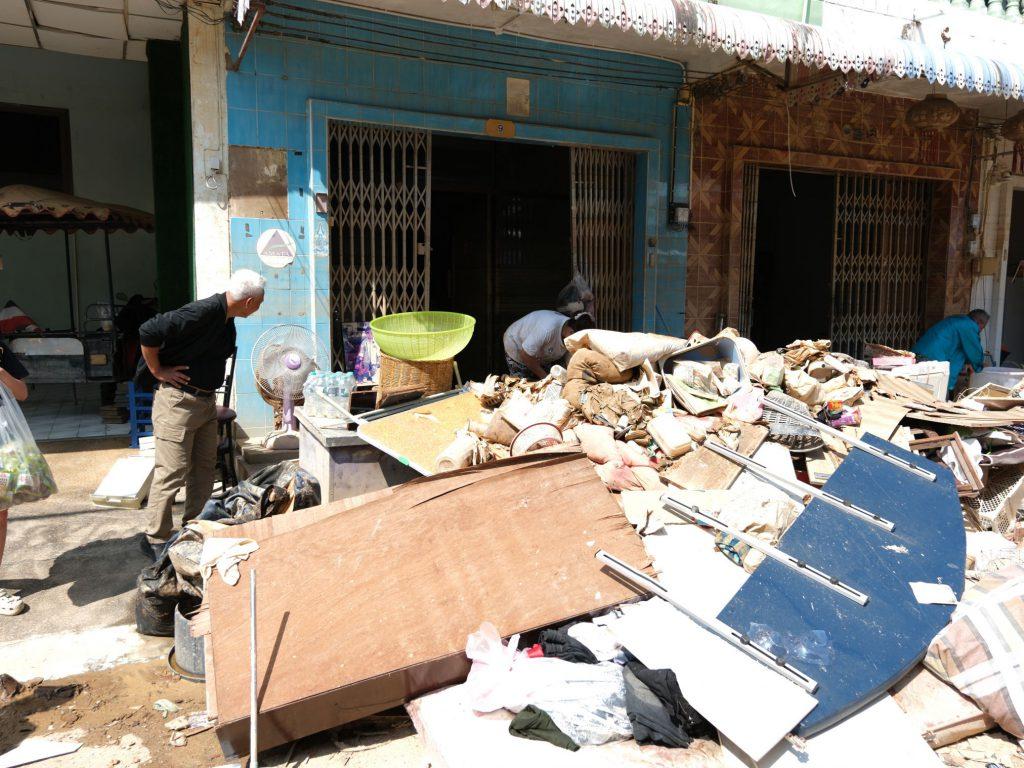
In the weeks following the initial flood response, CODI approved emergency housing repair budgets for 177 households across the five provinces including 73 homes with total structural damage and 104 with partial damage. The total disbursement of 3,423,580 baht was distributed proportionally to documented need, with Narathiwat receiving the largest allocation at 1,791,000 baht for 45 totally damaged homes.
CODI’s community war room, a coordination center aggregating field data and matching technical capacity to affected households, deployed community architects, tradespeople, and engineers across the repair effort. Priority went to elderly residents unable to navigate standard bureaucratic channels.
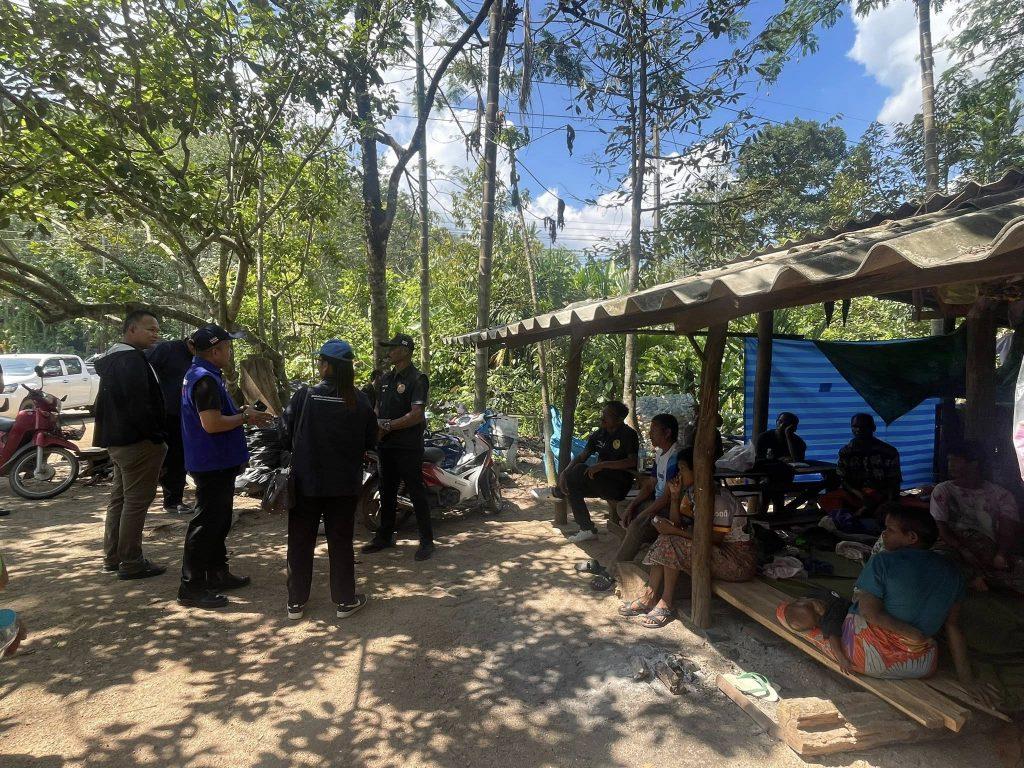
In Phatthalung Province, a longer-term housing initiative for the Maniq people, an indigenous community particularly exposed to landslides and flooding, was incorporated into the recovery framework. The disaster-resilient housing design process included Maniq participants of all ages, ensuring structures would suit both cultural practice and specific terrain.
Networks That Cross the Watershed
The organizational logic of the Southern network is territorial. It tracks the flow of water, not the boundaries of administrative districts. In Songkhla, community organizations divided their operational zone into three sectors aligned with hydrological geography which are a front zone along the coast, a peninsular zone along Songkhla Lake system, and an upland and urban zone covering Hat Yai. Each sector had its own operational focus, and the three sectors coordinated laterally rather than reporting upward to a single command.
The phrase that circulated through the network during the floods “older sibling helps younger sibling, friend helps friend” describes an organizational mechanism that communities with less immediate crisis supported those more severely affected. When Hat Yai network was managing urban flooding in Songkhla, it was simultaneously receiving and routing resources from networks further upstream. The network operated as a circulation system.
Support also arrived from outside the region. Southern Thai Community Association in Kanchanaburi Province donated one metric ton of rice, distributed to railway-side communities in Yala and networks in Pattani and Narathiwat. CODI’s Northeast regional office contributed rice to the Nakhon Si Thammarat central kitchen operations. The disaster activated inter-regional solidarity built through years of shared work.
From Lessons Learned to Institutional Change
The January 2025 floods did more than demonstrate the capacity of Southern Thailand’s community networks. They additionally exposed weaknesses in the country’s disaster management system and prompted a regional effort to strengthen community-led disaster management. In February 2026, Community Organizations Development Institute (CODI), community networks from fourteen southern provinces, and government partners had a meeting on translating operational lessons from the floods into a long-term framework for disaster preparedness. Rather than reviewing emergency response alone, participants focused on how community organizations could become permanent partners in disaster risk reduction, climate resilience, and recovery.
The discussions produced a shared vision of disaster management centred on community self-management. Participants agreed that local organizations should play a leading role in preparedness through continuous data collection, risk assessment, and coordination with public agencies. This approach shifts the focus from responding after disasters occur to reducing risk before emergencies emerge.
A central recommendation was the creation of a community-based early warning system that combines scientific information with local knowledge. CODI is working with Hydro-Informatics Institute, Department of Disaster Prevention and Mitigation, volunteer organizations, and community networks to improve access to hydrological and climate data. Community leaders will be trained to interpret rainfall forecasts, river conditions, and flood risks so that evacuation decisions can be made quickly using reliable local information.
Participants also emphasized that disaster preparedness depends on strong local institutions rather than emergency measures alone. Household databases, hazard maps, and community vulnerability assessments will be integrated into sub-district disaster plans, local land-use planning, and climate adaptation strategies. Information collected for community development will continue to serve multiple purposes, supporting everyday governance while strengthening preparedness for future disasters.
To support implementation, the network proposed a three-level governance framework. Regional and network partner level will establish regional disaster management working groups integrating representatives from community organization councils, community welfare, and Baan Mankong Program. This level coordinates with nine volunteer networks and sends community representatives to systematically develop and execute plans with partner agencies. The second is provincial and policy level which sets up provincial working groups aligned with regional structures. Responsibilities include developing a 2-year strategic disaster management plan, securing continuous funding from the Community Organizations Development Institute (CODI), and gathering sub-district risk data to build a comprehensive disaster database. Lastly, the sub-district level will drive local action through four main activities which are creating practical sub-district action plans, managing sub-district disaster funds, establishing local coordination centers, and providing skills training for local leaders and volunteers.
The workshop also identified reforms needed to enable community organizations to work more effectively with government agencies. These include greater flexibility in emergency funding, stronger legal recognition of community organizations within the national disaster management system, and policy reforms that support locally managed disaster funds and decentralized decision-making. Participants also proposed incorporating disaster preparedness into school curricula to strengthen risk awareness from an early age.
“We may not be able to prevent disasters, but we can manage the risks. When communities have access to information, the authority to make decisions, and a clear plan of action, they can transform themselves from disaster victims into communities that overcome disaster.”
– Komes Thongboonchu, Disaster Management Network, Nakhon Si Thammarat Province
From Community Development to Disaster Resilience: What are key takeaways?
The Southern Thailand experience demonstrates an important lesson for community development practice. The capacities enable communities to improve housing, savings systems, and local governance are often the same capacities that enable them to survive crises.
For decades, community development programmes have typically been evaluated primarily through their direct outputs, houses constructed, infrastructure upgraded, savings accumulated, or projects completed. The 2025 floods reveal another dimension of their value. Community surveys became emergency databases. Savings groups became communication channels. Community leaders became disaster coordinators. Housing networks became mechanisms for resource distribution and recovery planning. At the same time, the case reveals the limits of community action. Weak early warning systems, fragmented institutional coordination, and delayed public response mechanisms remain structural challenges that community networks cannot address alone. Resilience therefore requires partnership. Community organizations contribute local knowledge, trust, and rapid mobilization whereas government agencies contribute resources, technical expertise, and regulatory authority.
This transformation illustrates what resilience scholars describe as social capital and collective efficacy, the ability of communities to mobilize relationships, knowledge, and trust in pursuit of shared goals. The flood response was effective because they had already developed organizational systems through years of collective action. The case therefore suggests that community development should not be understood solely as a poverty reduction strategy. It is an investment in disaster preparedness, adaptive capacity, and long-term resilience. Development and disaster management are often treated as separate policy domains, yet the Southern experience demonstrates that they are deeply interconnected. Investments in community organization generate benefits far beyond their immediate objectives. Programmes designed to strengthen participation, collective action, and local leadership can also become critical foundations for disaster preparedness and recovery. The floods revealed what years of community development had already built.