by Pawinnut Chaiyasuan
What does it mean for a community to survive a disaster that was never inevitable? Natural hazards come with a certain tragic universality, indifferent to the borders they cross and the lives they interrupt. War does not. War is authored. It is determined in ministries, blessed by nationalists, and carried out on borders that were drawn by the ambitions of distant countries. Once shells hit a village straddling a border of nationality, the devastation is no different than that of an earthquake. Because its causes can be traced, its builders can be known, its consequences are therefore more difficult to absorb. The violence, in other words, was a choice.
The border conflict between Thailand and Cambodia in North Eastern area or Isan is a major man-made disaster. This disrupts the socioeconomic stability and physical security of people living in contested zones. In these contexts, protection cultures fall apart, which only serves to make the local residents more vulnerable. Therefore, disasters must be seen not as isolated incidents, but as symptoms of ongoing, underlying crises.
Ready, Set, Escape
30 seconds might be too short for many people to make a proper speech, to initiate something properly, or even to do daily chores, but for residents in the area of Thailand – Cambodian conflict, it was the duration people needed to take to hide and survive. The impacts of the conflict covered 28 sub-districts, 11 districts in 4 provinces, Ubon Ratchathani, Sisaket, Buriram, and Surin. When gunshots ring out, everyone in the community knows what to do. There is no time for meetings, and nothing for paperwork. The armed conflict along the border has forced communities to deal with a kind of disaster that is completely different from floods or earthquakes. There is no early warning system nor assessment. The first time it happened, it was disorganized and chaotic as it was not something people would expect nor predict. When the evacuation order came, residents rushed out in their cars at the same moment that military vehicles were pushing in the opposite direction, toward the fighting, on the same road. Two streams of vehicles, military vehicles and residents’, were moving against each other. Traffic became another challenge for people there.
“We were running and then we met the military trucks coming the other way
– same road, going in opposite directions.”
– Buriram Community Movement Leader
By the second round of clashes, the community had sat down with military officials and mapped out separate routes: one lane for evacuating residents, another for incoming troops. The adjustment represents the strength that a community stopped waiting to be managed and started co-managing the crisis itself.
“The second time, we already knew. The military goes this way, we go that way.
No crossing paths. Everyone stays safer.”
This is adaptive co-management where communities and state actors learn from shared experience and adjust together, in real time. “The best disaster management is that driven by ones who are affected,” said Assoc. Prof. Dr. Suttisak Soralump, Disaster Expert.
Cut Off from Everything
How would you live when money didn’t have as much power to exchange any longer? During the conflicted time, shops closed. Supply chains stopped. And in that sealed-off space, having money means nothing.
“The whole district empties out. Even if you have cash, there is nobody to buy from.
No shops open. People were hungry in those early days.”
The people who felt this most severely were not those who fled. They were the village security volunteers, the Chor Ror Bor, the small group authorized to stay behind and guard community property while everyone else evacuated. Within three days of the clashes, they had run out of food.
“Chor Ror Bor team and the community leaders stayed inside. After just three days of fighting, there was nothing to eat. Because nobody had prepared anything in advance.”
“Nobody had prepared anything in advance.”, It is not a complaint but a diagnosis. From that diagnosis, the community built its response. Community networks began organizing food supply chains, pooling provisions at the district level so that Chor Ror Bor members and government officials could bring supplies into the restricted area. At the same time, communities took on the task of cooking for front-line soldiers, since troops on active duty have no time to prepare their own meals. The food also needed to pass safety checks before soldiers could eat it. This small but important detail shows how deeply communities understood the logic of the situation, not just the basic needs.
The Edible Bunker
The hunger of those three days produced the most striking idea to come out of these communities. If the people who stay behind are going to survive inside a conflict zone, they need food that is already there. Food they do not have to go out and find. Food that does not require a supply chain to function.
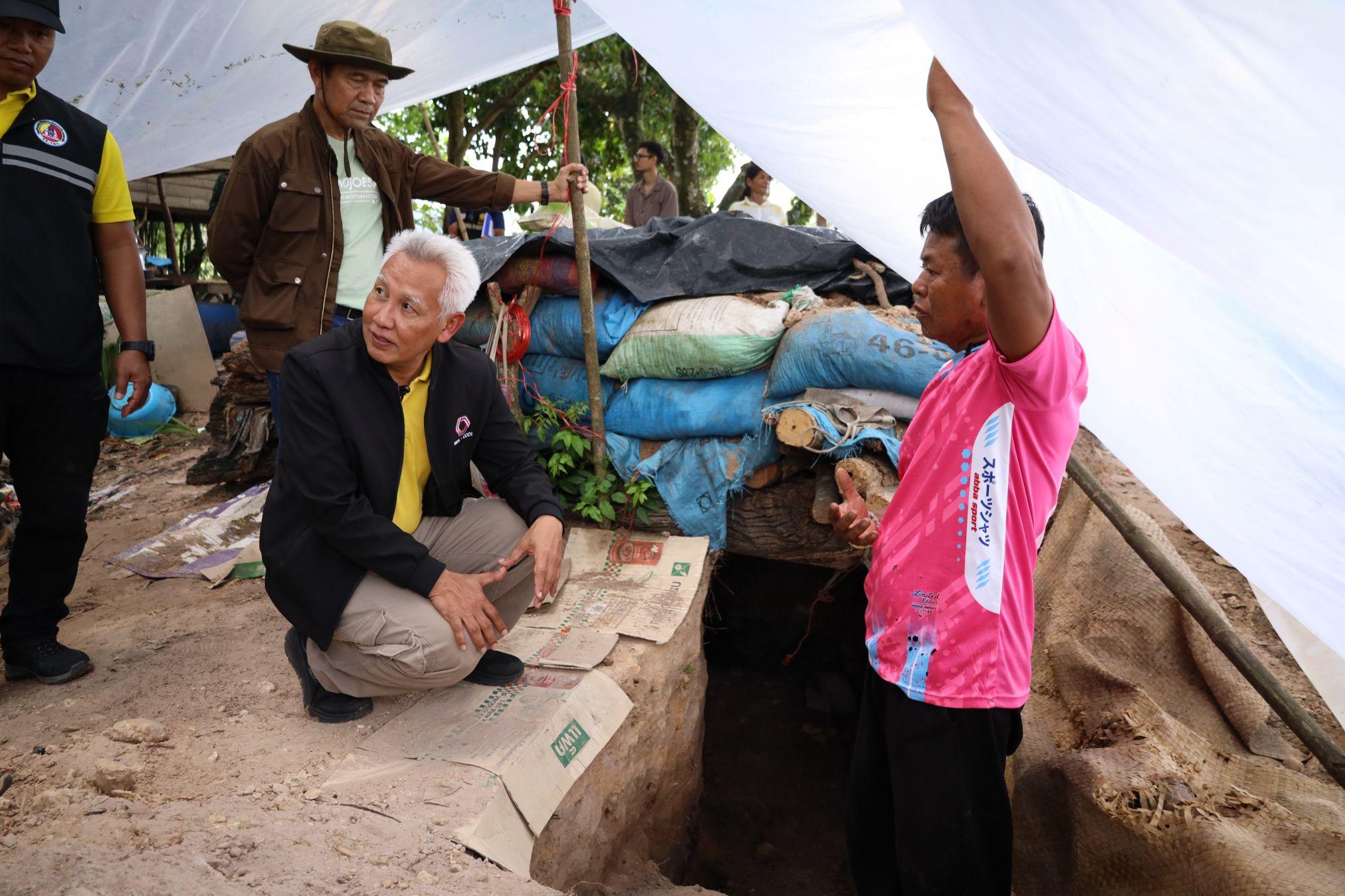
The community came up with an idea of planting vegetables around the bunkers. They called it the Edible Bunker. The concept is exactly what it sounds like, encouraging every household to grow food crops around their emergency shelter, so that anyone sheltering or guarding the area has something to eat without stepping outside the safe perimeter.
“We want to support every household to grow kitchen vegetables, to have food around their homes,
so that when you are sheltering in the bunker, there are vegetables, t
here is food close by, without having to move away from the bunker.”
By embedding food production into the physical infrastructure of protection, the edible bunker transforms a survival space into a living system. Communities also see potential beyond the crisis itself. There are plans to develop these bunker sites into learning tourism destinations. It will be places where visitors can experience what life under conflict conditions actually looks and feels like and witness the symbol of hardship, reconceived as cultural capital and community income.
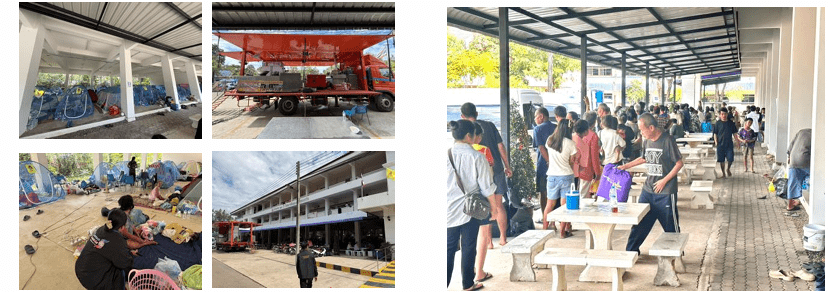
The Evacuation Center as a Place of Recovery
In most disaster response frameworks, evacuation centers are waiting rooms. People wait for instructions, for supplies, for someone to decide what happens next.
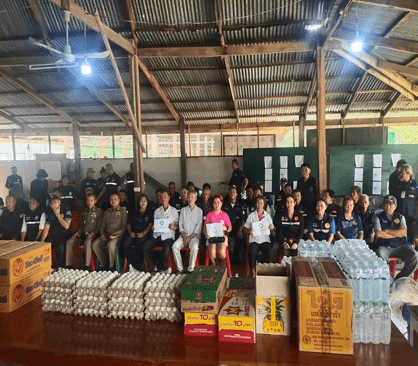
These communities decided not to wait. Working with Rajabhat University and the Department of Skill Development, community leaders organized short vocational training programs inside the evacuation centers, such as soap-making, snack production. Things that could be done in a small space, with limited materials, by people who were already there.
“Short vocational training helps livelihood after the conflict and also relieves stress. It is not just about drawing pictures with children or singing. We used vocational training as a shared activity for everyone at the center that is something people can do together.”
– A voice of a woman in the community
The programs were not described primarily as stress relief. They were described as shared activities, things people could do together. The psychological benefit came from the social process, not from being treated as trauma patients. This emphasizes social capital being activated through collective practice.
Alongside the training, communities also used pre-existing household data, the detailed settlement surveys that Thai urban poor networks have been building for years, to sort evacuees according to need. Sick residents and vulnerable groups were separated and given closer attention, preventing both confusion and neglect. It is a reminder that data built in ordinary times is what makes extraordinary times manageable.
Rebuilding Border Communities: A Strategic Framework for Post-War Recovery by Affected Communities
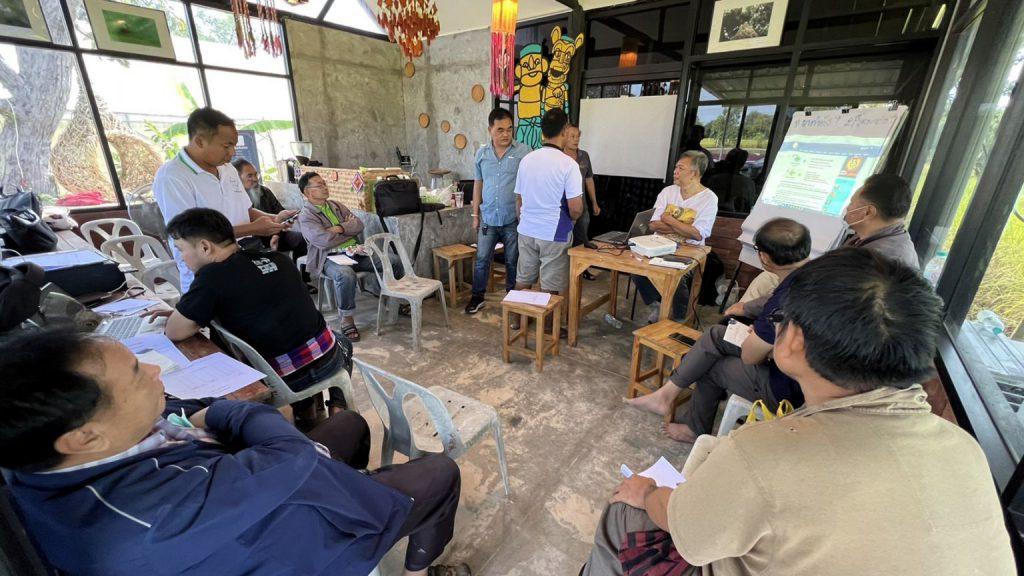
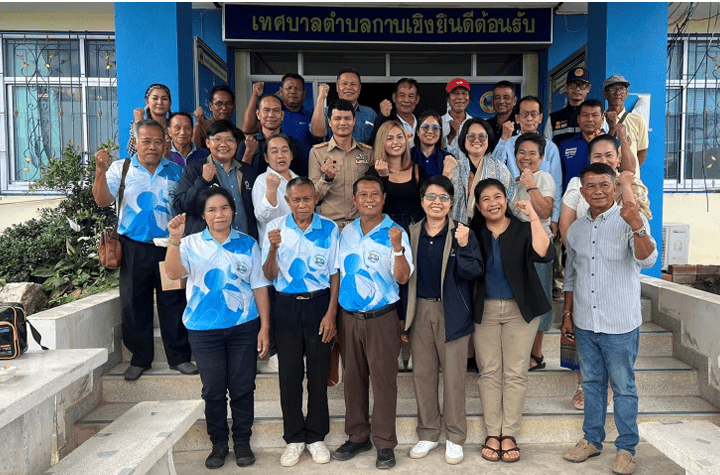
At multiple forums, local communities and network partners gathered to address war-related disasters in border areas. The discussion yielded strategic guidelines aimed at transforming affected conflict zones into secure, self-sustaining communities.
1. Anchoring Development via the Baan Mankong Border Rural Housing Security Model: The Baan Mankong project serves as a primary vehicle for broader community rehabilitation and long-term development. By replicating successful pilots from areas like Charat Sub-district (Surin) and Dom Pradit Sub-district (Ubon Ratchathani), this initiative aims to elevate the overall quality of life while securing land and housing for affected residents. To urgently address recent disaster impacts in these critical border regions, the Community Organizations Development Institute (CODI) and the Baan Mankong Subcommittee have allocated a total budget of 70 million baht nationwide. This includes an immediate 5-million-baht pilot fund dedicated to rapid recovery in the Southern Northeast and Eastern regions. According to Ms. Suthida Buasookkasem, Assistant Director of CODI, the core of this mission relies on utilizing precise, data-driven planning to effectively mobilize and connect with various network partners for maximum impact.
2. Restructuring Local Data through Sub-district Mapping: To ensure an effective response, the Community Organizations Council system must be revitalized to survey affected individuals and assess damages. By adapting standard housing security survey tools, communities can accurately map their layouts and design tailored safety systems that fit their specific local contexts.
3. Interconnecting the 7-Border Province Geo-Ecological Network: Recovery cannot happen in isolation. A collaborative network spanning seven border provinces (four in the Northeast and three in the East) will be established. This network will integrate operations between national security agencies and local grassroots organizations to ensure a unified approach to regional safety and development and improve early warning system.
4. Advocating for Sustained Government Policy and Funding: A formal mechanism will be established to present these grassroots proposals directly to the government. The primary objective is to secure continuous, long-term budgetary support from state policies, ensuring that rehabilitation efforts achieve lasting sustainability rather than relying on short-term relief.
Lessons in Resilience:
Community Strengths and Insights for Development Practice
Work with the State, not depend solely on the state
The communities truly see their potentials and collective power. They did not wait for the military to solve the logistics problem. They negotiated and worked with them as a peer actor. The same pattern appears in the food supply chain as they worked through district-level government channels to move provisions into restricted areas. The communities are neither absorbed into state structures nor isolated from them. This power becomes one of the most valuable things to have in a crisis.
Data built in ordinary times
The household databases that allowed communities to sort evacuees by vulnerability separating sick members, identifying people who needed close medical attention were not built during the emergency. They were built before it, through the kind of routine community surveying. The Baan Mankong program’s household data systems in Thailand are a direct example of this. Crises reveal what baseline systems already exist so the disaster response can flow faster.
Psychosocial recovery was embedded in productive activity
The vocational training programs in evacuation centers were framed as shared activities, not therapy. This matters because it treats evacuees as people with capacity, not as trauma cases to be managed. The social process of doing something together produced the psychological benefit. Once the members are strong enough, the strength allows them to additionally think of others and then innovations can be created, such as the edible bunker which came from the idea of people running out of food.
The core lesson of this case is that the best disaster management is driven by those who are directly affected. True resilience is built by combining localized data, collective community action, and real-time coordination with their network partners, including state authorities.