
Translated by Pawinnut Chaiyasuan
For many low-income and homeless individuals in Thailand, the lack of affordable, secure housing is not just a shelter problem as it is a barrier to stability, employment, and reintegration into society. To address this, the Community Organizations Development Institute (CODI), through its Working Group for the Development of Housing Projects for the Welfare of the Poor, has been piloting a model of affordable welfare rental housing built on collaboration bringing together government agencies, Bangkok Metropolitan Administration, academic institutions, and civil society. Rather than a one-off solution, this model is being tested, refined, and scaled with the aim of shaping national housing policy for the poor.
The working group for the Development of Housing Projects for the Welfare of the Poor has conducted a study on development guidelines for rental housing as welfare for low-income individuals and coordinated with network partners, including the Bangkok Metropolitan Administration (BMA), academic institutions, the Department of Social Development and Welfare, and the Thai Health Promotion Foundation. The results of the pilot welfare rental building constructions are as follows:
(1) Baan Poon Suk Homeless Capacity Development Center, Pathum Thani Province
This is a pilot area for affordable rental rooms and one of the shelters for the homeless that resulted from the collaboration between the Ministry of Social Development and Human Security (MSDHS), the Thai Health Promotion Foundation (ThaiHealth), the Human Settlement Foundation, the Homeless Association, the Community Organizations Development Institute (CODI), and civil society. The center was established with the intention for the homeless to manage it themselves. A plot of land measuring 2 Rai, 2 Ngan, and 42 Square Wah was purchased for 19.5 million Baht, featuring one existing building that can accommodate 100 homeless individuals from areas such as Don Mueang, Chatuchak, Pathum Thani, and Rangsit. The goal is to provide shelter, vocational training, and an improved quality of life, enabling them to live with others in society or return to their families. Nationwide surveys found 2,669 homeless individuals. The center includes living quarters, activity rooms, meeting rooms, vocational training areas, and recreational spaces, as well as vegetable gardens and a mushroom house for food and income generation.
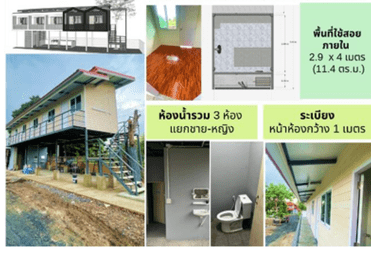
In 2024, the Institute collaborated with the Human Settlement Foundation and the Homeless Association to design affordable rental rooms tailored to the needs of the homeless. Five rooms were developed on a 99-square-meter area, with each room measuring 2.9 x 4 meters (11 sq.m.). There are three shared bathrooms separated by gender. The rental rate is 1,800 Baht per month, equipped with convenient electricity and water systems. Currently, all rooms are fully occupied.
(2) Liap Wari 79 Housing Welfare Building, Nong Chok District, Bangkok
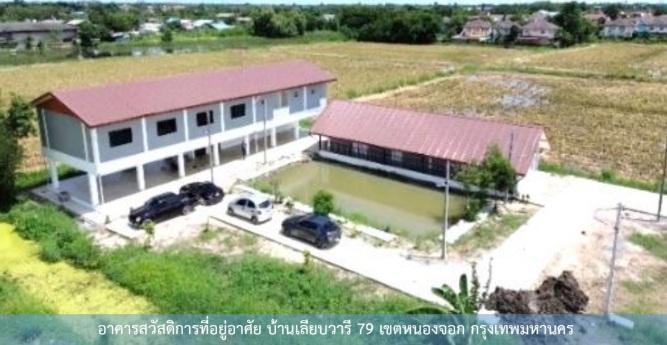
This project originally received support from CODI to be established as a new community for the homeless who have elevated themselves through better jobs and income. Developed on a 2-Rai area, the project designed 14 rooms with en-suite bathrooms. These are divided into:
1. Large rooms: 4×4 meters (16 sq.m.) at a rental rate of 1,500 Baht per month.
2. Small rooms: 2×3 meters (6 sq.m.) at a rental rate of 1,200 Baht per month.
The area includes a meeting room and green spaces for communal activities and relaxation. Construction and utility systems (electricity and water) have been completed. Currently, the selection process for residents is underway, with plans to develop social spaces and quality-of-life improvement areas for future occupants.
(3) Coordination with the Bangkok Metropolitan Administration (BMA) and development partners to develop the Maen Si Waterworks building for low-income residents
Initially, the plan designates a 3-story building (Baan Im Jai) for the homeless and a 6-story building as rental rooms for low-income individuals and first-time jobbers. The team of architects from Bangkok City Lab and King Mongkut’s Institute of Technology Ladkrabang is overseeing the implementation. A Maen Si Line group has been established for support and progress tracking.
(4) Policy-level drive for housing projects for the welfare of the poor
The policy drive is to serve as a key government policy. This is currently a significant policy of the Ministry of Social Development and Human Security, as declared by the Minister on September 19, 2023. It is also included in the (draft) Housing Action Plan (2024 – 2037).
What emerges from these efforts is a working model for how affordable, dignified housing can be delivered through partnership rather than isolated intervention. By starting small steps such as testing designs, rental structures, and management approaches at the community level, CODI and its partners are building the evidence and momentum needed to move this work from pilot to policy. With its inclusion in the draft Housing Action Plan (2024 – 2037) and backing at the ministerial level, affordable welfare rental housing is positioned to grow from a handful of pilot sites into a lasting, nationwide response to housing and human insecurity.
Although the low-cost welfare rental housing project is currently operated by Community Organizations Development Institute (Public Organization), it originated from a joint development concept between the Human Settlement Foundation and the Homeless Association and other state agencies like MSDHS, ThaiHealth and BMA. They share the same goal which is developing housing to accommodate all vulnerable groups in society. However, more importantly, no matter how much housing is developed, if it lacks processes or activities to change the tenants’ mindset so they have goals to move forward, this project might not be considered entirely successful. Therefore, it must be carried out in parallel with multidimensional development for this project to achieve its true objectives.
